The Man Who Taught BMW to Keep Quiet
An idle argument in a group chat about three body shapes runs into one man's biography, and into a question that costs more than taste: who pays for beauty, and with what.
In this issue


Arguments about beauty are usually barren. Everyone keeps their own position, the reasoning comes down to "just look at it", and twenty messages later the subject dies. But now and then a system shows through a casual list, and the conversation turns out not to be about taste at all.
In a car chat where I normally just read, someone wrote: E24, E34, E38 are the most beautiful BMWs ever built. The 6 Series of 1976–1989, the 5 Series of 1988–1996, the 7 Series of 1994–2001. Three different classes, three decades, three buyers with nothing in common.
I was about to answer that this was personal taste, and stopped.
If it is taste, the coincidence is a strange one. If it is not taste, somebody specific stands behind that list.
Somebody does. His name was Claus Luthe, and his career ended in a single day in the spring of 1990, in circumstances that keep his name half-spoken even among people who look at his work every day.
The bill comes first
We have to start earlier, though, with a car that is not on that list and that nearly killed the company.
In the middle of the fifties the American importer Max Hoffman was telling Munich that America wanted a beautiful German roadster, a rival to the Mercedes 300SL. In 1956 the 507 arrived: a hand-formed aluminium body, a 3.2 litre V8, around 150 horsepower.1
The car came out flawless to look at and catastrophic as economics. It cost almost twice what it was meant to sell for, and every copy sold lost money. Production stopped in 1959 after 252 cars.1
The company lost fifteen million marks that year, and BMW was kept out of bankruptcy by the money of the industrialist Herbert Quandt.1252507s built in three years. Every one sold lost money.
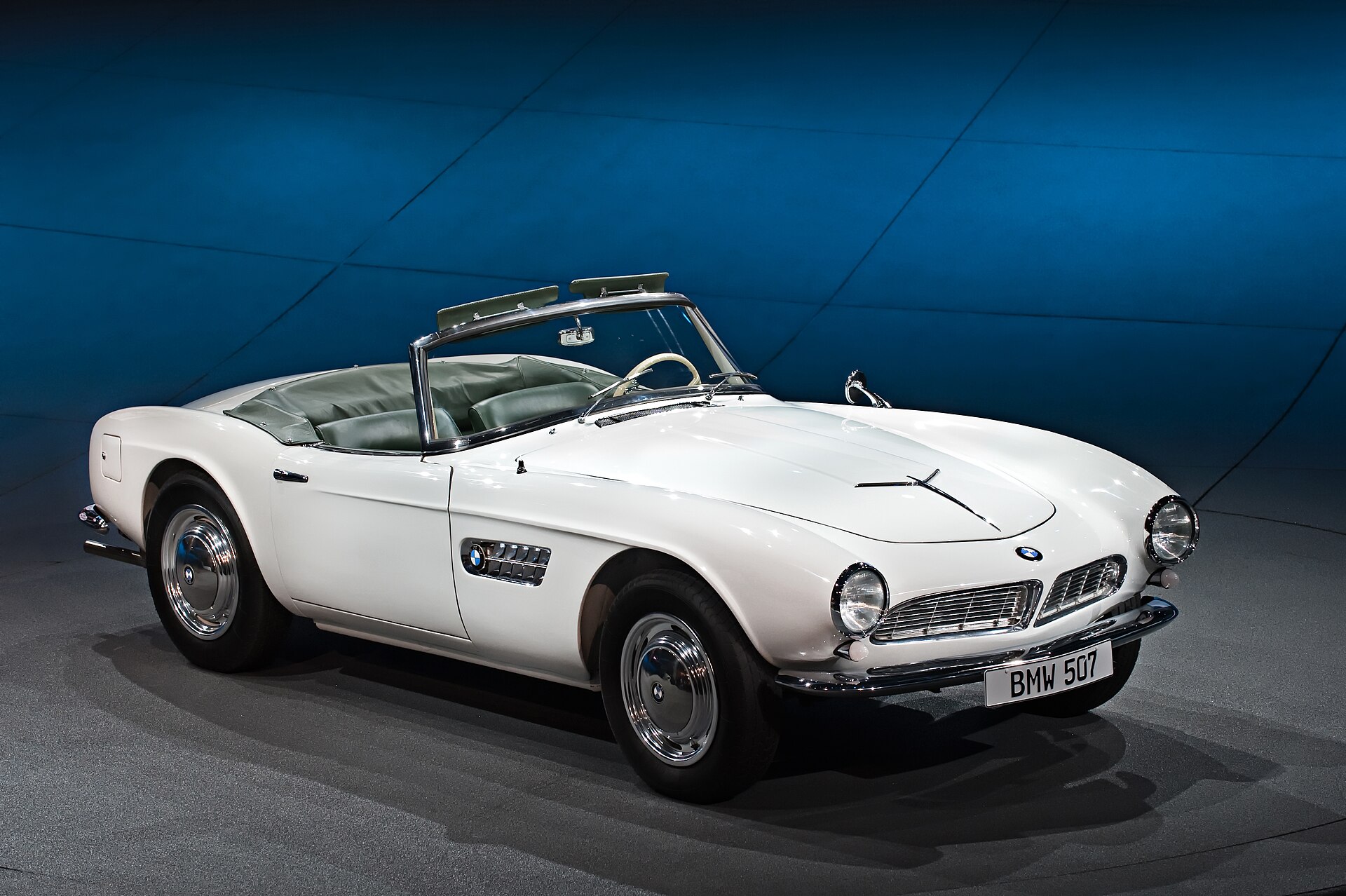


The story has a glossy side. One of the 507s was bought by Private Presley, then serving in Germany, who had it repainted red.1 The fame, accordingly, went to Elvis. The bill stayed with the company.
It also has a sober side. Beauty pursued for its own sake had already brought this company to the edge of disappearing. Everything that happens to BMW design afterwards happens with that bill in view.
The wedge that changed the shape of the car
Luthe did not arrive at BMW as a boy. He already had behind him a car that historians of design call the forerunner of everything modern in the industry: the NSU Ro 80 of 1967.2
Today its silhouette looks ordinary, and that is the finest compliment a designer can be paid. A low nose, a high tail, one line running through the body from headlamp to tail light, a lot of glass and thin pillars.
In 1967 nobody looked like that. For the next twenty years the whole industry, from Audi to the Japanese, would work that idea out. A wedge instead of a box.1967the year of the NSU Ro 80. Nine years later its author would take charge of design at BMW.


There is a fine anecdote about the Ro 80. Owners are said to have greeted each other with raised fingers, showing how many engines they had been given under warranty. Historians do not confirm the scene, but it did not come from nowhere.
The rotary engine wore out so briskly that some cars needed a rebuild before fifty thousand kilometres and a few before twenty four thousand. The generous warranty under which NSU replaced the motors damaged the company's finances beyond repair.2 The design was ahead of its time. So, unfortunately, was the mechanical side: it managed to grow old before its time instead.
In 1976 Luthe took charge of design at BMW, succeeding Paul Bracq.3 And this is where it gets interesting, because the shark nose was not his idea.
Another man's handwriting, put on discipline
Before the rules, it is worth looking at the house they were written in. The tower on the cover of this issue was built between 1968 and 1972 to a design by the Austrian Karl Schwanzer, in time for the Munich Olympics.4
Four vertical cylinders hung from a central core repeat the shape of an inline engine, and the museum beside it is built as the cylinder head.
The logic is the same as in the cars. The form is not invented on top of the content, it is derived from it. The building does not depict speed and is not decorated with anything that does not work, exactly like the bodies discussed below.
Construction finished in 1972 and the complex opened on 18 May 1973.4 Both dates fall inside the stretch when Paul Bracq was drawing the first 5 Series, four years before Luthe arrived.1972the year BMW got both a headquarters shaped like an engine and the E12, which set the template for two decades of bodies.
A handsome coincidence, but not an accidental one. In those years the company was working out, at the same time, how its products and its own house ought to look. In 1999 the tower was listed as a monument,4 which is to say the decision outlived most of the cars it was taken for.
The forward-leaning face with two narrow nostrils came to BMW from Paul Bracq, a Frenchman who arrived from Mercedes-Benz and led BMW design from 1970 until he left for Peugeot in 1974.5 His E12, the first 5 Series, set the template, and the silhouette of the E24 is his line too.
Luthe overturned nothing. He did something rarer: he took another man's find and turned it into a code of rules. A long bonnet and short overhangs. Thin pillars and a lot of glass.
No decorative creases down the flank; the line runs from headlamp to tail light and does not argue with itself. The instrument panel is turned towards the driver. The nostrils stay narrow: an identifying mark, not a shop window.
That last point deserves a pause, because anyone seeing a current BMW grille for the first time is entitled to suspect we are discussing a different marque.
Out of this code come the three cars named in the chat. What they share is not a shape; their shapes differ. What they share is that all three were made under one statute.


The E34 is the purest case. A saloon that does not try to be liked. Not one accent anywhere, the whole of its expression handed to proportion. Which is exactly why it is the most arguable item on the list. Its beauty is functional; it is impeccable rather than expressive, and next to more passionate cars it reads as a calm company vehicle.


The E38 is formally not his. The 7 Series arrived in 1994, four years after Luthe left. But it was made by the same rules, and it became the last 7 Series argued over not as "like it or not" but as "how close to perfect".
Popular culture worked in its favour too. In the 2000s the car turned into all but obligatory equipment for films about composed men in dark suits. In The Transporter it out-acted, to my eye, half the cast.
Good Friday
In April 1990, four years before the E38 would appear and carry his line on without him, Claus Luthe killed his son. Ulrich was thirty three. He had been dependent on alcohol and pills for years. The quarrel happened at home, on Good Friday.3
In December 1990 a court convicted him of manslaughter in a less serious case. He agreed early retirement with BMW but stayed on as a freelance consultant. He died on 17 March 2008, aged seventy five.3 Company material says little about him, and it is easy to see why. There is no way for a corporation to tell this story so that it does not blot out everything else.
And everything else is the face of the marque for two decades. The cars posted in chats today under "they knew how back then" were drawn in the studio of a man whose private life ended as badly as a life can end.
Usually the phrase "an era ended" covers a change of fashion or a sales report. Here it is a specific date and one evening.
What came next
On 1 October 1992 design at BMW was taken over by the American Chris Bangle.6 By the early 2000s he had broken precisely the rules Luthe had built.
Surfaces became creased, volumes argue with one another, and the tail of the 7 Series acquired a nickname there is no need to reproduce here. Customers were furious, sales rose, and within a few years competitors began to copy it.1992Bangle took over design two years after Luthe left. The argument about who was right is still running.
Arguing about who was right is pointless. It is an argument about different jobs. Luthe worked at a company that remembered the bill for the 507 and demanded that beauty be a by-product of discipline. Bangle worked at a company selling a million cars a year that needed to be noticed.
But the list from the chat does prove something. Three cars from different classes and different decades, named in one breath, are not a coincidence of taste or nostalgia for the nineties. They are the recognition of a system.
The man who listed them was not responding to "beautiful" but to internal consistency: here no line argues with another, because somebody once forbade them to argue.
And what he named, to be exact, are not the most beautiful BMWs ever built. The 507 was passed over, and so was the E9, a coupé lovelier than the E24 and lighter than it; so was the E31 with its pop-up headlamps.


What he named are the most beautiful cars inside one school. Inside it, the aim is true.
What interests me most in this story is that the man in the chat almost certainly knew nothing about Luthe, nothing about Bracq and nothing about the bill for the 507, and still named three cars from one studio in a row. Discipline in a shape is felt even by people who have never heard the word discipline applied to design.
Next in the journal
If you are interested in authorship, industrial design and facts repeated without a source.
The occasion
August 2026
An argument in a car chat: someone called three body shapes the most beautiful BMWs ever made. I was going to reply in one line that beauty is a matter of taste, went to check who had drawn them, and lost two evenings. The one-line reply never happened.
The Reading section is made of exactly this: things that started as a remark in a message thread and turned out to be a story.
Response
Reactions are anonymous. One per reader; click again to remove it.
Photograph credits
- 1 BMW 507, Wikipedia: built 1956–1959, 252 cars, hand-formed aluminium body, 3.2 litre V8, 150 PS; costs pushed the German price to DM 29,950 and BMW lost money on every car; the company lost DM 15 million in 1959 and bankruptcy was averted by Herbert Quandt; the idea was Max Hoffman's (1954); Presley's 507 was repainted red. Correction, 30 August 2026: the first version said 254 cars; the correct figure is 252.
- 2 NSU Ro 80, Wikipedia: designed by Claus Luthe, 1967; some cars needed a rebuilt engine before 50,000 km and some before 24,000; a necessarily generous warranty policy undermined NSU's finances irreparably. Removed, 30 August 2026: the claim that more than two thirds of the replaced engines had been healthy could not be supported.
- 3 Claus Luthe, German Wikipedia (head of design from 1976, succeeding Paul Bracq; April 1990; convicted in December 1990 of manslaughter in a less serious case; agreed early retirement with BMW and stayed on as a freelance consultant) and the English article (8 December 1932 – 17 March 2008). Corrections, 30 August 2026: the first version said Luthe never returned to the profession, which is wrong, and described his son as drug-dependent, where the German source says dependent on alcohol and pills. The English source does say "drug-dependent": the disagreement between sources is left visible rather than smoothed over.
- 4 BMW Headquarters, Wikipedia: architect Karl Schwanzer, built 1968–1972, opened 18 May 1973, listed as a protected historic building in 1999; four vertical cylinders with the museum as the cylinder head. Correction, 30 August 2026: the first version said the headquarters opened in 1972.
- 5 Paul Bracq, Wikipedia: ten years at Daimler-Benz, design director of BMW from 1970 (succeeding Wilhelm Hofmeister), initial designs of the E12, E21, E24 and E23; at Peugeot from 1974.
- 6 Chris Bangle, Wikipedia: chief of design at BMW from 1 October 1992, left on 3 February 2009.
- 7 BMW E24, 1976–1989. BMW E24 IMG 2094.jpg, Alexander-93, CC BY-SA 4.0.
- 8 635CSi, rear. BMW 635CSi E24 (15901874151).jpg, Jeremy from Sydney, Australia, CC BY 2.0.
- 9 635CSi cockpit. BMW E24 635 CSi Grp A Cockpit2.JPG, Micham6, CC BY-SA 3.0.
- 10 BMW 525i (E34), front. BMW 525i (E34) in Khon Kaen Thailand front.jpg, M.rJirapat, CC BY-SA 4.0.
- 11 1993 M5, rear. BMW M5 (1993) (53686112505).jpg, Charles from Port Chester, New York, CC BY 2.0.
- 12 E34 interior. 5-er e34 Interior BMW PL.JPG, Beemwej, CC BY-SA 3.0.
- 13 BMW 728i (E38), front. 1999 BMW 728i 2.8 Front.jpg, Vauxford, CC BY-SA 4.0.
- 14 E38, rear. BMW E38 rear 20080108.jpg, Rudolf Stricker, CC BY-SA 3.0.
- 15 740iA interior, 1996. BMW E38 740iA-96 interior.jpg, Fredrik rr, CC BY 3.0.
- 16 BMW 507, 1956. BMW 507.jpg, Stefan Krause, Germany, CC BY-SA 3.0.
- 17 507, rear. 1959 BMW 507 white rear (D.M. Verkehrszentrum).jpg, User:Mattes, Public domain.
- 18 507 interior. BMW 507 Retro Classics 2025 DSC 7650.jpg, Alexander Migl, CC BY-SA 4.0.
- 19 BMW 3.0 CSL (E9), front. BMW 3.0 CSL (front) (16438234024).jpg, Mark Walker from Chester, UK, CC BY-SA 2.0.
- 20 CSL, rear. BMW 3.0 CSL (rear) (16438238084).jpg, Mark Walker from Chester, UK, CC BY-SA 2.0.
- 21 E9 panel, 1973. MMWA 1973 BMW E9 Coupe-Dashboard.jpg, ZidaneHartono, CC BY-SA 4.0.
- 22 NSU Ro 80, 1967. NSU RO 80 side.jpg, Oliver Kurmis, CC BY 3.0.
- 23 Ro 80, front. NSU RO 80 front.jpg, Oliver Kurmis, CC BY 3.0.
- 24 Ro 80 at a classic meeting. NSU-ro-80-avant-04-11-06.jpg, Julien FLORENT, CC BY 2.5.


