Crossing the Line Twice
Linie really does send aquavit across the equator. But the tale of five unsold casks in 1805 turns out to be a later legend, not an established fact.
In this issue
Vodka is the only spirit defined by an absence. Not by what it contains, but by what its makers have managed to remove.
That is not a figure of speech. It is the letter of the law. The European regulation on spirit drinks defines vodka as a product whose raw materials have had their organoleptic characteristics selectively reduced. It also specifically allows treatment with activated charcoal.
The entire process is subtraction. A rectification column, then filtration, then more filtration. Perfect vodka is a product brought to perfection by removing everything that might otherwise have been perfected.37.5%the minimum alcoholic strength of vodka under EU rules. The rest of the definition is largely about what to remove, not what to add.
There is a qualification. Vodka with no taste at all is a fairly recent ideal and partly a marketing construction. Connoisseurs still argue about softness and raw materials, and potato vodka does differ from wheat vodka. But the direction of travel remains the same. Improvement means removing something else.
The starting material across northern Europe was broadly similar: grain or potato spirit. Each country then had to decide what to do with it. Subtraction was not the only road, nor even the busiest one.
The Dutch added juniper and made genever, from which gin would grow a century later. Scandinavians added caraway, dill and anise and made aquavit.
Everyone else infused herbs, berries and roots. Not out of a devotion to complexity, but because before the rectification column, spirit was not pure enough to boast about. Subtraction became possible late. Until then, the only strategy was concealment.
The Norwegians found a third option, one that fits neither branch. They began sending their aquavit across the equator and back. They still do.
That was where this began for me. I remembered hearing that the Dutch sent some kind of vodka across the equator before putting it on sale. I went to check. The Dutch were not involved, and neither was vodka. Everything else was true, and the truth was stranger than the story.
The drink is the Norwegian aquavit Linie. The name means line, as in the equator. Every bottle you can take from a shelf really has crossed it twice. The back label tells you the ship and the dates. This is not advertising copy but a claim with a name and dates that can be checked.
There is a Dutch connection too, although not the one you might expect. We will come back to it at the end.
The story the brand tells
In the brand's present account, the Lysholm trading house in Trondheim sent a shipment of aquavit to the East Indies in 1805, bound for Batavia, now Jakarta and then the capital of the Dutch colonies.
The log of Trondhjems Prøve records an equator crossing on 24 October. Three days earlier, the Battle of Trafalgar had decided who would command the oceans for the next century, but there was no way for anyone on board to know.1805Norway still belonged to Denmark, Batavia was still Dutch, and the Lysholms were not yet distillers.
In that account, the aquavit failed to sell in Batavia. Five unwanted casks were sent home by the same route, spent nearly two years in the hold and were unloaded in Trondheim in 1807.
They were supposedly opened in the expectation of writing off the loss. Instead, the drink was markedly better: softer and rounder, with sherry notes from the casks.
The documents tell another story
The problem is not merely that the usual brand account moves quickly here. The cargo records examined by Trond Åm do not support its premise.
The Lysholm family had left the trading house about fifteen years before the voyage; Hans Knudtzon owned it. A 1940 account of the cargo lists five casks of spirit and eight cases containing 669 bottles of red wine, plus four casks of grain spirit as ship's stores. It does not list unsold aquavit casks returning from Batavia.
Jørgen Bernhoft Lysholm, whose name appears on the bottle, was nine years old in 1805. His father and uncle founded a soap factory at Fagerheim. Jørgen did not take ownership and convert it into a distillery until 1821.
In other words, at the time of the celebrated voyage, the Lysholms did not yet produce aquavit. The bottle says "since 1805", but the documentary link between that voyage and Linie's origin has not been established.16years between the date in the legend and the beginning of production.
The explanation offered by local sources in Trøndelag is prosaic and rather likeable. From the late 1830s, Trondheim developed an export trade in dried fish to South America. Lysholm began sending aquavit in oak barrels as deck cargo on the outward and return journeys. Not for romance, but because the ships were going anyway.
The drink found its character as a sideline to the dried-cod trade, not on a heroic expedition.
Older accounts connect Linie's origin with the regular dried-fish trade of the late 1830s. According to Åm, the link to Trondhjems Prøve first appears in Hroar Dege's 1997 book. The honest version is therefore narrower: the sea maturation is real, the commercial tradition is documented, and the elegant founding incident of 1805 remains a brand legend.
How it works now
The first thing to understand is that this is not a souvenir edition. Every drop crosses the equator.
The aquavit is distilled from potatoes, flavoured with caraway, anise, dill and coriander, then filled into 500-litre oloroso casks. The casks are ten to fifteen years old and thoroughly seasoned with sherry.
Total maturation lasts about sixteen months. Less than a third of that time is spent at sea. The rest happens ashore, as it does for everyone else.
The casks travel on the upper deck in ventilated containers, not in the hold. That distinction matters. Conditions below deck would be too stable. What the process needs is sun, day-to-night temperature changes and motion. At any given time more than a thousand barrels are at sea, taking up about five per cent of a ship's container capacity.
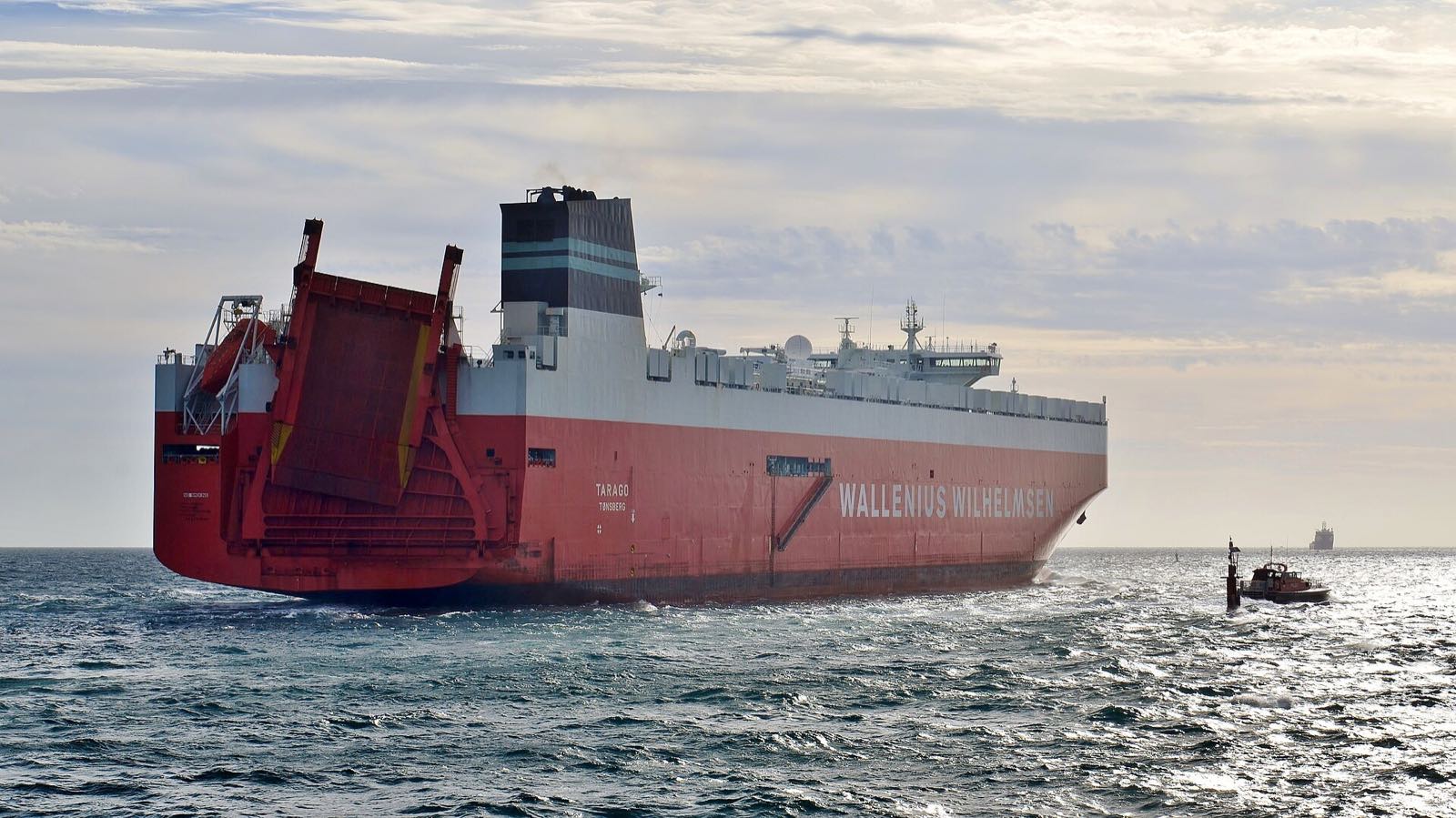
The carrier has been the same since 1927: Norway's Wilh. Wilhelmsen. The first vessel in the arrangement was the liner Tungsha, which sailed for Australia carrying barrels loaded in Oslo.
The shipping line is paid rent and receives a case of Linie at Christmas, perhaps making it the only company in the world that invoices someone for leaving their alcohol in the sun.1927the year the voyage stopped being incidental cargo and became a schedule.
A voyage lasts about four months, calls at more than twenty ports in North America, Latin America and Asia, and crosses the line twice.
The bottle that names the ship
Here the brand does something rare in the drinks trade. The back label shows the route, the name of the ship and two dates: departure and return. Enter the batch number on the website and you can retrieve the particular voyage.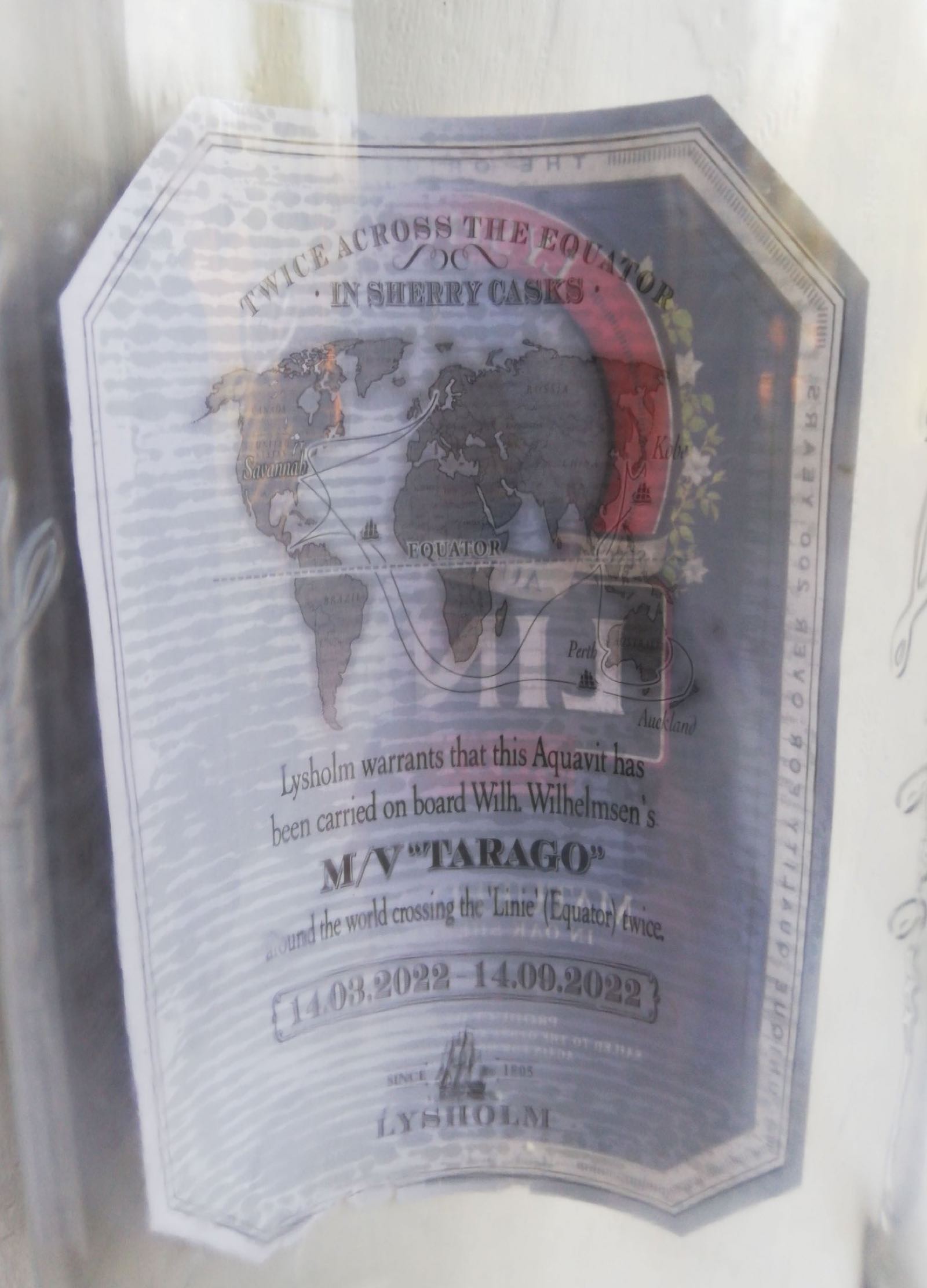 What the back label tells you. A route through Savannah, Kobe, Perth and Auckland, the ship and two dates: 14 March and 14 September 2022. Exactly six months at sea. The ship was Tarago.2
The label shown here belongs to a bottle that travelled aboard M/V Tarago from 14 March to 14 September 2022. Exactly six months, considerably longer than the usual four. Schedules are schedules; logistics are logistics.
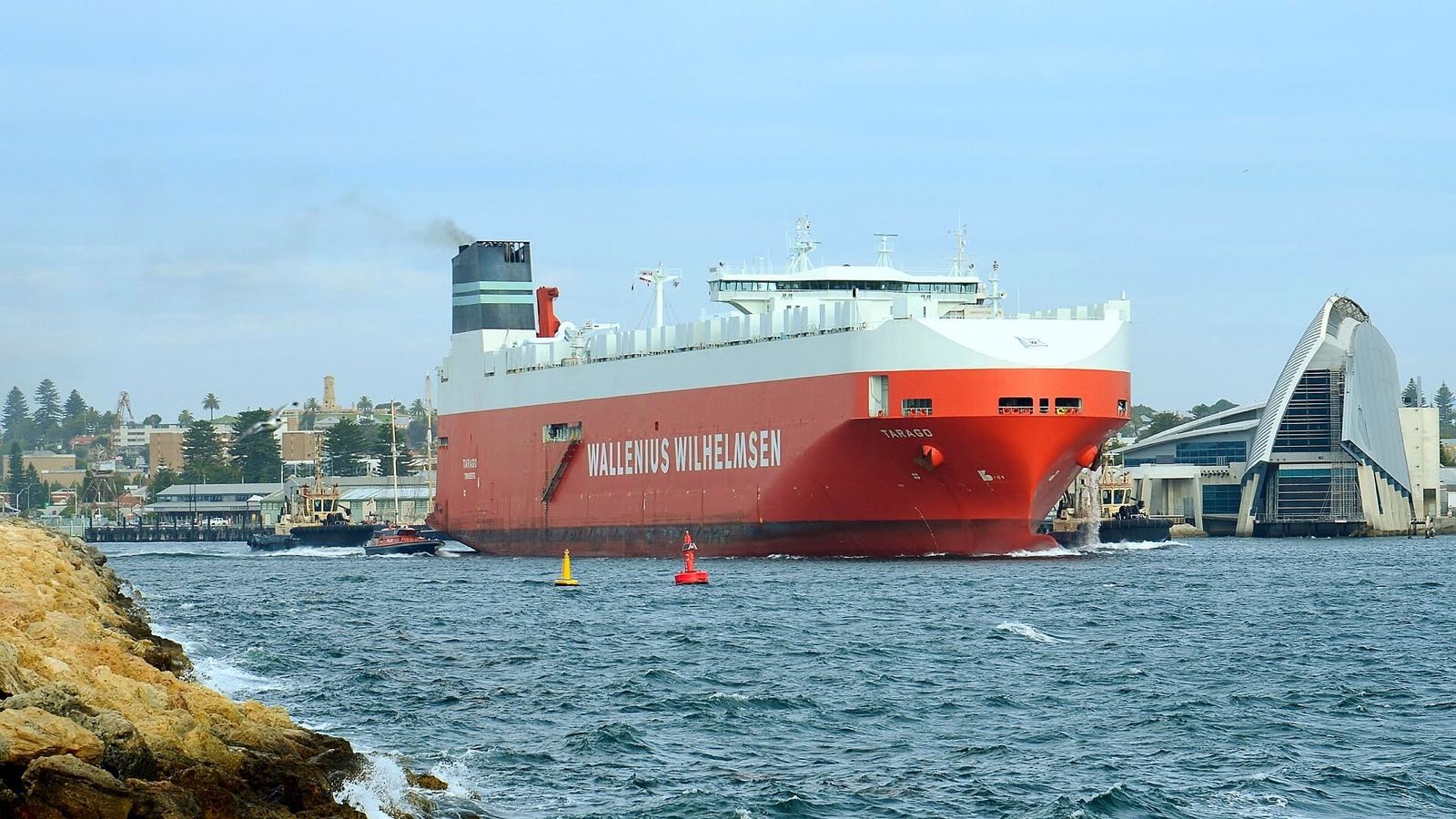
Tarago is a Wallenius Wilhelmsen car carrier registered in Tønsberg. In the photograph above she is leaving Fremantle, the port of Perth. Perth is one of the stops printed on this very label.
The barrels of aquavit therefore ride on the upper deck of a ship filled with new cars, seeing more countries along the way than the average buyer of those cars will see in a lifetime.
Madeira solved the same problem and admitted it
Now for the part omitted from the Norwegian version because it spoils the plot.
The same effect was discovered on Madeira, and earlier. In the eighteenth century, casks were loaded as ballast and sent to India and back because the wine returned better than it had left.
The practice became known as vinho da roda, wine of the round voyage, and was considered a mark of the highest quality. Buyers specifically requested wine that had visited the tropics.
In 1794, a man named Pantaleão Fernandes installed the first estufa, a heated room in which wine could simply be kept warm to imitate a tropical hold. The process survives as estufagem. Madeira openly acknowledged that heat was doing the work and replaced a round voyage with a radiator.1794the year a heater first replaced the voyage, apparently without sacrificing the result.
This raises an awkward question for the Norwegians. If temperature cycling is what matters, why send barrels around the world when a heated warehouse and a fan would do?
Does it work at all?
The honest answer is that the mechanism is plausible, but the size of the effect is unknown.
The physics is straightforward. As the liquid warms, it expands into the wood; as it cools, it withdraws. This breathing speeds extraction. Changes in pressure and humidity alter the headspace in the barrel. Motion increases the extent and duration of contact with the wood. All of this really happens.
What has not happened is a clean published comparison. In 220 years, nobody has shown the same spirit in identical barrels, one sent to sea and the other left behind.
The nearest attempt came from the cognac house Ferrand, which matured samples in a dry cellar, a humid cellar and on a barge. The cellar difference was detectable, but the maritime sample was kept in smaller barrels. Two variables changed at once, so the experiment answered neither question.
Billy Abbott of The Whisky Exchange puts the objection more bluntly. Charring a barrel, he says, changes a spirit far more than carrying it on a ship. That does not mean the sea does nothing. It means its contribution has never been measured against much larger factors.
It is not difficult to guess why. The experiment would be cheap, but the answer might be inconvenient. Then somebody would have to explain why they had been paying the freight all this time.
What are you really buying?
Several producers now repeat the maritime ritual. Jefferson's Ocean bourbon travels the oceans, Never Say Die whiskey goes from Kentucky to England, and Ferrand keeps barrels on a barge on the Seine.
None has a proper control group. All have a story. In a world where almost every spirit is sold with vague claims about selected casks and generations of craft, I am prepared to believe that an honest, verifiable story is worth something in itself.
An ordinary spirit tells you it was aged for twelve years in selected barrels, claims that are impossible to inspect and need not be demonstrated. Linie gives you a ship and two dates, the one completely verifiable fact in the entire category. The verifiable part may also be the part that makes no difference.
This leads to a conclusion I like more than the drink. Industries are perfectly capable of preserving rituals whose mechanisms they have never tested, while making those rituals transparent down to the last date. Transparency and proof are different things. They are confused all the time, and not only in drinks.
Madeira is more candid. It decided that heat was the active ingredient and stopped burning fuel for appearances. Norway is more romantic. It kept the voyage and sells the voyage with the contents. I am not sure the second strategy is worse. At least the romance has a batch number.
And the Dutch, where this story began? They do have a large place in maritime drinking, just in a different genre. Genever, the ancestor of gin, travelled in barrels aboard Dutch East India Company ships. English soldiers brought it home from continental wars, along with the phrase Dutch courage.
Genever is also aged in oak, but nobody carried it across the equator to improve its flavour. They carried it because people aboard wanted something to drink, which, when you think about it, is a far more practical tradition.
That story is for another time.
Next in the journal
If you are interested in authorship, industrial design and facts repeated without a source.
The occasion
22 August 2026
That evening I remembered, vaguely, that the Dutch sent some kind of vodka across the equator and only sold it afterwards. I meant to check one fact before bed.
I had the country wrong and the drink wrong. The practice itself turned out to be older and more interesting than the legend around it, and beneath it was a question nobody had managed to settle in 220 years. The checking took an evening; the writing took the next day.
24 August. I sent Linie one question: have they ever run a controlled comparison using the same spirit and identical barrels, with one batch sent to sea and the other kept in a warehouse? If an answer arrives, it will appear here in a dated section of its own. I will record the silence too.
Response
Reactions are anonymous. One per reader; click again to remove it.
Sources
- 1 Photographs of M/V Tarago in Fremantle, 29 December 2015. Bahnfrend, CC BY-SA 4.0, via Wikimedia Commons.
- 2 Back label of a bottle of Lysholm Linie Aquavit. Mojmir Churavy, CC0, via Wikimedia Commons. Contrast increased for legibility.
- 3 The brand's own material: the voyage and batch-number search.
- 4 VinePair and Tales of the Cocktail: interviews with the master blender, deck conditions and the proportion of a vessel's capacity occupied by the barrels.
- 5 Jørgen B. Lysholm and two hundred years of aquavit in Trøndelag.
- 6 Club Oenologique on dynamic ageing, Maison Ferrand's experiment and Billy Abbott's objections.
- 7 The legal definition of vodka: Regulation (EU) 2019/787, Annex I, paragraph 15.
- 8 Madeira and the transition to estufagem: The Rare Wine Co. and Discovering Madeira.
- 9 Trond Åm, “Linjakevitten - en myte blir skapt”, AquaVIT, no. 4, 2017. Åm compares the brand story with the cargo record of Trondhjems Prøve and earlier accounts of Linie's origins.